 Meltemi
One product, two surfaces, three platforms
A headless daemon holds every capability. Two thin clients consume it over a local socket, and core parity is a rule with a blocking test behind it: no capability may reach one surface and not the other.
Desktop client
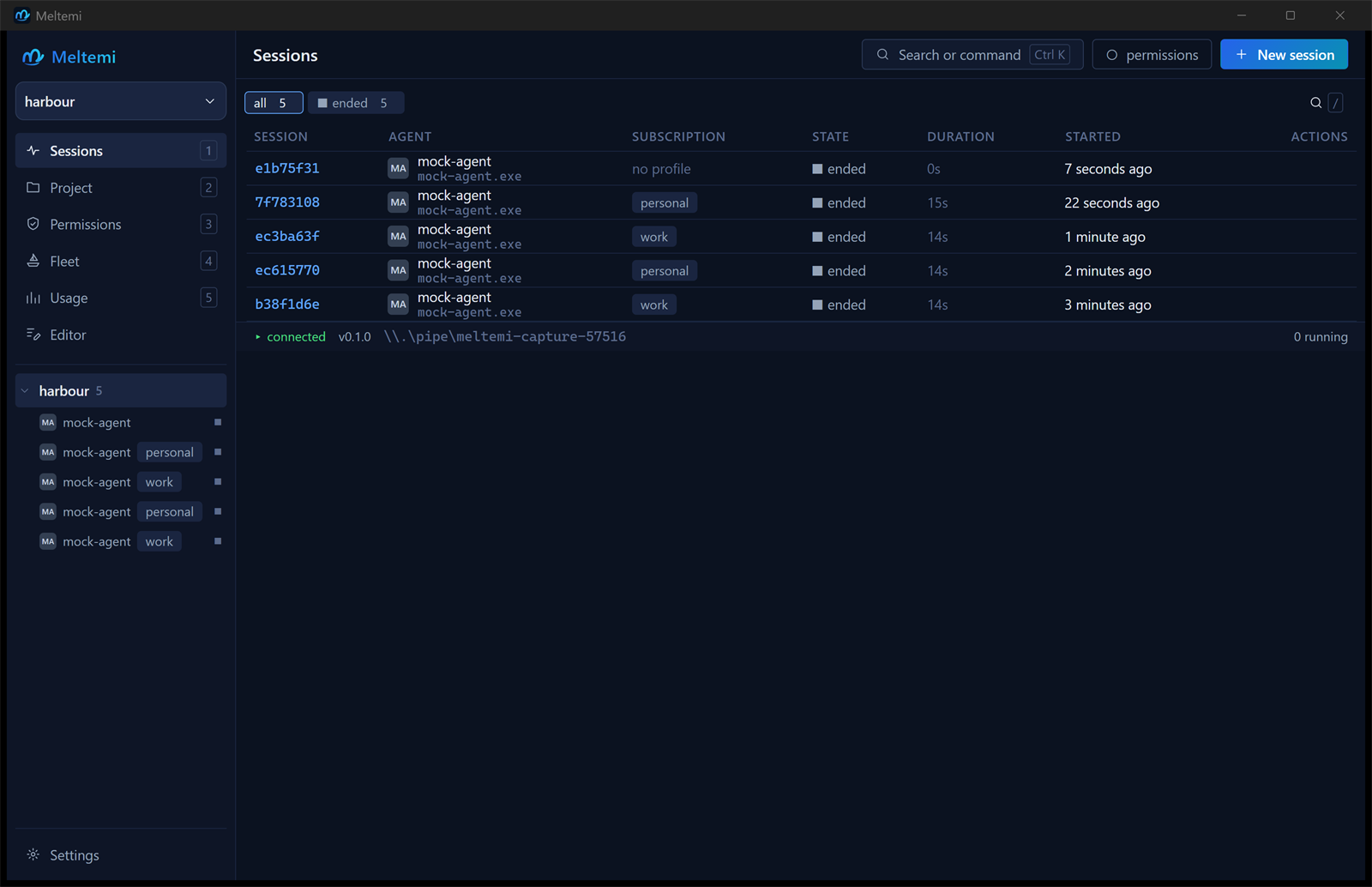
A dense, keyboard-first application: sessions and their transcripts, the permission tray, the project view, the fleet of agents, local usage accounting and a utilitarian code surface with review of every diff before it lands.
Terminal client
The same capabilities in the terminal, plus a scriptable command layer with machine-readable output — the surface that fits a pipeline, an SSH session or a keyboard-only workflow.
Windows, macOS, Linux
All three are first class and all three are tested on every change. Windows is not a later port: the daemon speaks a named pipe there and a user-only socket elsewhere.
Bring your own agent, key and model
No credits, no fees, no lock-in. Meltemi runs the official binaries of the agents you install, each authenticating itself the way its vendor intends. It never reads, stores or forwards your credentials, and it never impersonates another client. If you hold two subscriptions of the same provider, launch profiles let both run at once, in separate projects and sessions.
No telemetry
Every metric is computed locally. There is no network port in the daemon and nothing to opt out of, because there is nothing being sent.
Local usage accounting
Sessions, prompts, permissions, edits and commits folded from your own records — and tokens only where an agent's official output reports them. What was never measured is shown as not reported, never as a zero, and never as an estimate.
Apache 2.0, permanently
The daemon, both clients and the future SDK are Apache-2.0 and will not change licence.
The surfaces, as they actually render

Honest state, before 1.0
What does not exist yet, stated plainly:
| Capability | Status | Notes |
|---|---|---|
| Daemon, terminal surface, spec engine | Published | Signed releases with per-platform archives. |
| Desktop client | In development | Installers ship with each release; the shell is being polished. |
| Public SDK | Not yet | Planned for phase 2, after the contract settles. |
| Mobile companion | Not yet | Specified for phase 3; nothing is shipped. |
What Meltemi is not
Not a general-purpose editor: the code surface is utilitarian, in service of the agent loop, and sustained authoring stays in the editor you already love. Not another coding agent. Not a cloud service, not CI/CD, and not a marketplace.
The full argument lives in the foundational document and the constitution, both readable in full: the manifesto and the constitution.